Table of Contents
- What Is Red Light Therapy for Collagen?
- How Red Light Therapy Works at the Cellular Level
- Collagen, Elastin, and Skin Aging: Why They Matter
- Evidence: What Studies Show About Skin Aging
- Benefits for Skin Health and Skin Conditions
- Is Red Light Therapy Safe?
- Professional LED Panels vs At-Home Devices
- What to Expect During a Session
- Who Is (and Isn’t) a Good Candidate?
- How Often to Use Red Light for Collagen
- Common Mistakes to Avoid
- FAQs About Red Light Therapy for Collagen Production
- Why Choose Our North Andover Wellness Center
- Next Steps: How to Book a Red Light Therapy Session
What Is Red Light Therapy for Collagen? (Quick Answer)
Red light therapy is a non-invasive treatment that uses specific wavelengths of visible light and near-infrared energy to stimulate collagen production beneath the skin’s surface. The treatment relies on light-emitting diodes (LEDs) that deliver red wavelengths ranging from 630 to 660 nm for skin treatment, along with near-infrared wavelengths around 800–880 nm that penetrate deeper into the dermis. Unlike ablative lasers that remove layers of tissue, red light therapy does not heat or damage skin. It works by gently encouraging the body’s own cellular repair processes.
At our wellness center in North Andover, Massachusetts, we use professional-grade LED panels calibrated to these evidence-based wavelengths. Clients come to us concerned about skin aging, fine lines, declining skin elasticity, and overall skin quality-and this therapy directly addresses those concerns at their root.
Collagen and elastin are the essential proteins that keep skin firm, smooth, and resilient. Red light therapy aims to slow and partially reverse visible signs of aging by helping the body produce more of both. Here is a quick snapshot of what consistent treatment can support:
- Softer fine lines and wrinkles around the eyes and mouth
- Firmer skin texture and improved skin tone
- Better overall skin health and resilience
- Complementary effects on recovery and reducing inflammation
- A non-invasive approach with no downtime
How Red Light Therapy Works at the Cellular Level
Think of red light therapy as charging your skin cells rather than burning or peeling them. Red light penetrates the skin to rejuvenate it at a cellular level, reaching the dermis where collagen is actually made.
When red and near-infrared photons enter the skin, they are absorbed by mitochondrial chromophores-most importantly, the therapy activates cytochrome c oxidase in mitochondria. This triggers a chain of events that enhances mitochondrial ATP production, giving cells significantly more energy to work with. Red light therapy also reduces oxidative stress in cells and dials down pro-inflammatory signals, which supports skin health and may calm certain skin conditions without serving as a cure for them.
That increased ATP availability is where the real collagen story begins. Red light therapy stimulates fibroblasts to increase collagen and elastin production. Fibroblasts are the workhorse cells of the dermis, and when they have more energy, they synthesize more structural proteins. Red light therapy enhances ATP production, boosting collagen synthesis in a measurable way. Research also shows that photobiomodulation upregulates genes like COL1A1, COL3A1, and ELN, while downregulating matrix metalloproteinases-enzymes that break down existing collagen.
Red light therapy also improves blood flow through mild vasodilation, which means improved blood circulation contributes to oxygen delivery and nutrient supply to the skin. This combination of increased cellular activity, reduced inflammation, and better circulation creates an environment where skin cells can rebuild and maintain their structural framework more effectively.
Results are cumulative and depend on dose. Wavelengths, treatment time, power density, and distance from the light all influence how much collagen production your skin can generate over a treatment series.
Collagen, Elastin, and Skin Aging: Why They Matter

Natural collagen and elastin production begins to slow in the mid-20s. By the time most people reach their 30s, their body is producing roughly 1% less collagen per year. Over decades, this gradual decline leads to fine lines, wrinkles, and loss of skin elasticity that becomes increasingly visible.
Collagen gives skin its structure and fullness. Elastin allows skin to stretch and snap back. When production slows for both of these proteins, the result is the familiar progression of skin aging: thinner skin, sagging along the jawline, and creases that deepen around the eyes and mouth. Environmental factors common in New England-strong summer UV exposure that causes sun damage, harsh winter dryness, and urban pollution-accelerate the breakdown of these fibers even further.
Traditional anti-aging approaches like retinoids, chemical peels, microneedling, and ablative lasers can be effective. But they often involve downtime, irritation, or higher risk for sensitive skin types. Red light therapy offers a different approach: a supportive, non-injury-based modality that helps nudge the body’s own collagen and elastin production without breaking the skin barrier.
Consider the difference in goals: someone in their early 30s might use red light therapy as prevention, maintaining collagen levels before visible damage sets in. Someone in their 50s might incorporate it into a broader skin rejuvenation plan alongside facials, hydration therapy, or targeted skincare-using the therapy to rebuild what time and environment have taken away.
Evidence: What Studies Show About Red Light Therapy and Collagen Production
Research on red light therapy for collagen production is growing. While study protocols still vary in wavelength, dose, and duration, several randomized controlled trials have produced measurable improvements in skin aging markers.
One landmark controlled trial with 136 volunteers treated twice weekly for approximately 15 weeks found statistically significant results. Participants experienced an intradermal collagen density increase of about 5.75 units measured by high-resolution ultrasound, plus a reduction in skin roughness of roughly 1.8 units measured by profilometry. About 69% of treated subjects were judged “improved” by independent expert assessment.
Clinical studies indicate that consistent red light therapy results in measurable skin improvements across multiple parameters. In published data, red light therapy reduces crow’s feet wrinkle depth by 15.6%. Skin elasticity increased by 12.5% after two months of treatment. Dermal density improved by 26.4% after one month of use-a finding confirmed by a separate observation showing a 26.4% increase in dermal density after 28 days of treatment. Collagen production supported by red light therapy results in thicker dermal density overall.
Additional findings from a crow’s feet LED mask study combining 630 nm and 850 nm wavelengths showed that 86% or more of treated subjects experienced meaningful improvement in fine lines over 16 weeks. These were reported in journals including Lasers in Surgery and Medicine (lasers surg med), Seminars in Cutaneous Medicine and Surgery (semin cutan med surg), Photomedicine and Laser Surgery (photomed laser surg), and Laser Therapy (laser ther). Researchers including Austin E. and Sadasivam M. have contributed significantly to this body of evidence, and references appear across publications in Lasers in Medical Sciences (lasers med sci).
Optimal results may take 4 to 12 weeks to become noticeable, and not all devices or protocols will reproduce identical percentages. Results depend on wavelength, energy dose, skin type, age, and consistency. Red light therapy supports skin rejuvenation and collagen production, but it is not a substitute for surgery where major laxity exists, and it should not be framed as a miracle cure.
Benefits for Skin Health and Skin Rejuvenation
The cosmetic benefits of red light therapy center on what happens when the dermis starts producing more collagen and elastin. Improvements in skin texture and firmness occur with consistent use of red light therapy, and numerous studies confirm the following outcomes:
- A meaningful reduction of fine lines and wrinkles, particularly around the eyes and mouth
- Better skin elasticity along the jawline and cheeks, contributing to a firmer appearance
- Smoother texture with improved skin quality and a more luminous, even skin tone
- Collagen production improves skin firmness and elasticity across treated areas
- Red light therapy decreases pore diameter by 28.5% after one month
- A 34.9% reduction in sebum levels was observed after one month, which may benefit oily or acne-prone skin
Red light therapy may also help with early signs of skin aging such as mild sagging, dullness, and roughness when used consistently for several weeks. Some studies indicate red light may help protect existing collagen from breakdown, adding a protective dimension beyond just stimulating new growth. Red light therapy can lead to a reduction of fine lines and wrinkles that is gradual and natural-looking.
For specific skin conditions, the therapy shows promise as supportive care for acne-related redness, post-inflammatory marks, and acne scars. Its anti-inflammatory properties make it useful for reducing inflammation at the surface level, calming irritated skin cells, and supporting tissue repair and wound healing. Red light therapy may reduce inflammation, promoting healthier skin over time. However, it functions as an adjunct-not a standalone medical treatment-for serious medical conditions or common skin conditions that require dermatological care.
Lifestyle synergies matter. Combining red light therapy with consistent sunscreen use, adequate hydration, quality sleep, and an anti-inflammatory diet can maximize visible skin rejuvenation. The therapy works best as one piece of a well-rounded approach to youthful skin, not as a replacement for basic skin repair habits.
Is Red Light Therapy Safe?
Red light therapy is considered safe, non-toxic, and free of ionizing radiation. It does not use cancer-causing UV light, which means it does not tan or burn the skin. Red light therapy is generally safe for the vast majority of adults when used according to established protocols, and is considered safe across a range of applications from skin health to recovery.
Many LED and low-level laser devices have received FDA clearance for specific uses, but that clearance applies to defined indications and device types, not to every product on the market. The distinction matters when evaluating at-home devices versus professional systems.
Typical short-term reactions are mild and resolve quickly:
- Temporary redness at the treatment site
- Mild warmth or slight tightness during or after a session
- Occasional skin sensitivity that does not require downtime
Side effects may include temporary skin redness, but these are not persistent in standard protocols. Long-term safety of red light therapy devices is unknown-research continues, and this is precisely why professional supervision, proper eye protection, and adherence to recommended dose and frequency are important. Overuse of red light therapy can damage skin or eyes, making it critical to follow guidelines rather than assuming more exposure equals faster results.
Specific contraindications and precautions include:
- Photosensitive disorders such as lupus or other autoimmune conditions
- Taking photosensitizing medications, including certain antibiotics, isotretinoin, or photodynamic therapy agents
- Uncontrolled health conditions or medical conditions affecting the skin
- Pregnancy, where evidence is limited, and a medical provider’s input is prudent
- Suspicious lesions or a history of skin cancer in the treatment area
Red light therapy is safe when administered correctly, but a brief screening conversation before starting treatment helps ensure the therapy is appropriate for your individual situation.
Professional LED Panels vs At-Home Devices
The main difference between in-studio and at-home devices comes down to power, precision, and oversight. Professional systems in a wellness center typically use larger, more powerful LED arrays with calibrated settings. Clinic devices often deliver 40–150+ mW/cm² of irradiance, while consumer masks and wands usually fall in the 5–30 mW/cm² range.
In-studio sessions allow better dose control across wavelength selection, panel distance, session length, and total energy delivered per treatment. Professional settings also provide safety oversight-proper eye protection, trained practitioners, and the ability to integrate red light therapy with other services like facials or infrared sauna sessions.
At-home devices can serve as a useful maintenance tool between professional treatments. However, they often require longer or more frequent use to approach similar results. A professional session might deliver 20–60+ J/cm² of energy in a single visit; a consumer mask may deliver under 10–20 J/cm², meaning you need more sessions per week to reach comparable cumulative energy.
Safety tips for home use:
- Avoid looking directly into bright LEDs
- Follow manufacturer instructions for session length and frequency
- Do not stack multiple devices or extend sessions to try to “speed up” results
- Choose devices with verified wavelength and irradiance specifications
A practical approach for many clients: complete a series of professional sessions to jump-start collagen production with consistent, calibrated dosing, then transition to a vetted at-home device for long-term skin health support between visits.
What to Expect During a Red Light Therapy Session
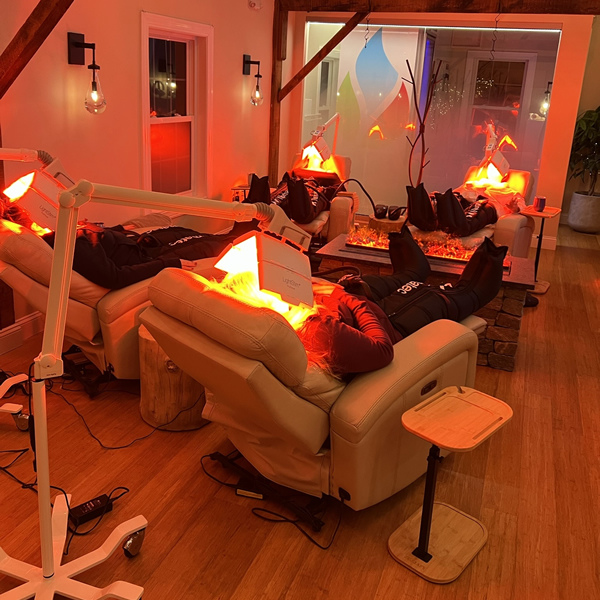
A red light therapy session is calm, warm, and entirely non-invasive. Red light therapy is a non-invasive treatment that requires minimal recovery time, and initial sessions typically last 10 to 20 minutes each.
Here is the typical visit flow at our North Andover wellness center:
- Check-in and consultation – A brief conversation about your skin goals, health conditions, and any relevant medical history
- Preparation – Cleansing of the face and positioning on a treatment bed with protective eye shields
- Device setup – The practitioner selects red and/or near-infrared wavelengths, adjusts panel distance, and sets the session timer based on your skin type and goals
- Treatment – You’ll see a bright red light and feel gentle warmth. There are no needles, no skin ablation, and no pain. Many clients relax, listen to music, or meditate during the session
- Post-treatment – No downtime. You can return to work or errands immediately. An optional moisturizer or antioxidant serum compatible with light therapy may be applied
Patient satisfaction tends to be high because the experience itself is pleasant, and because there is no recovery period to plan around.
Who Is (and Isn’t) a Good Candidate for Collagen-Focused Red Light Therapy?
Red light therapy is suitable for a wide range of ages and skin types because it is non-thermal and does not injure the surface of the skin. Red light therapy typically works well across all Fitzpatrick skin types when administered at appropriate doses.
Ideal candidates include:
- Adults in their late 20s–40s looking to prevent or soften early signs of skin aging
- People in their 50s–60s seeking gentle skin rejuvenation without invasive procedures
- Athletes and active individuals who also value recovery benefits from light therapy
- Clients with sensitive skin who cannot tolerate stronger peels or lasers
- Anyone interested in boosting collagen as part of a broader wellness routine
Those who should seek medical clearance first:
- Individuals with lupus or other photosensitive autoimmune conditions
- Those taking photosensitizing medications such as certain antibiotics or isotretinoin
- People with a history of skin cancer or suspicious lesions in the treatment area
- Anyone with uncontrolled medical conditions that may affect healing or skin response
People with very advanced skin laxity may benefit most from combining red light therapy with other procedures. A consultation helps set realistic expectations and determine whether light therapy alone is sufficient or whether a multi-modal plan makes more sense.
At our center, a brief intake and skin assessment is used to personalize light therapy parameters and ensure safety before a single session begins.
How Often to Use Red Light Therapy for Collagen and Skin Rejuvenation
Consistency drives results with this therapy. The general pattern follows an initial intensive phase and then transitions into maintenance.
The recommended frequency is two sessions per week for three months, which aligns with the protocols used in the strongest clinical trials. Sessions should be spaced 72 hours apart for optimal results, giving skin cells time to respond and rebuild between treatments. Red light therapy typically requires this kind of structured approach to produce meaningful change.
For many clients, noticeable changes start around weeks 4–8, with the best results around 8–12 weeks of consistent treatment. Cumulative benefits are achieved with consistent treatment over weeks-this is not a one-and-done therapy. Regular sessions of red light therapy can lead to significant collagen increases when the protocol is followed.
Maintenance phase options:
- Weekly sessions to sustain collagen production and skin elasticity
- Bi-weekly sessions for clients who have completed a full initial series
- Supplemental at-home device use between professional visits
Maintaining results from red light therapy requires ongoing treatment sessions. The natural aging process does not stop, and without continued stimulation, production gradually returns to baseline over time.
Exact frequency and duration should be customized during consultation. Factors like skin type, age, other treatments you may be receiving (such as facials or microneedling), and your schedule all play a role in designing the right plan.
Common Mistakes and Myths About Red Light Therapy
Many misunderstandings about red light therapy come from social media claims and inconsistent product quality. Here are the most common mistakes and myths worth correcting.
Common mistakes:
- Assuming “more is better” and overusing devices beyond recommended session lengths-overuse can damage skin or eyes
- Expecting overnight transformation instead of the gradual, cumulative improvements that red light therapy offers
- Relying on light therapy while neglecting SPF, hydration, or picking at the skin
- Using poor-quality devices with incorrect wavelengths, unknown irradiance, or no third-party validation
- Skipping sessions and then doubling up, which disrupts the 72-hour spacing that optimizes a small number of sessions per week
Common myths:
- Red light therapy is the same as tanning. It is not. Red light does not contain UV and does not tan or burn.
- It can cure serious skin conditions or medical conditions on its own. It is supportive care, not a standalone cure.
- It replaces sunscreen. Absolutely not. Sun damage continues regardless of light therapy.
- It can permanently “stop” aging. It supports cellular activity and slows visible decline, but aging is a biological process that continues.
Red light therapy is a tool for supporting skin health and collagen production as part of a broader routine. A practical tip: keep a simple treatment log noting dates, session duration, and other skincare steps. Tracking subtle changes over time helps you see the real, incremental progress that photos taken weeks apart often reveal clearly.
FAQs About Red Light Therapy for Collagen Production
Does red light therapy really boost collagen production?
Yes, to a meaningful but realistic degree. Red light therapy increases collagen production by activating fibroblasts in the dermis, and controlled studies have confirmed increased markers of collagen along with improved skin firmness after weeks of consistent LED treatments at proper wavelengths and doses. Improvements are typically moderate and natural-looking-not as dramatic as surgery or deep resurfacing lasers- which helps set accurate expectations. Numerous studies published in peer-reviewed journals support these findings.
How long will it take to see results in my skin?
Some people notice subtle changes like increased glow and softer skin texture within 2–4 weeks. More visible changes in fine lines, texture, and skin elasticity often appear between 6–12 weeks. Results depend on session frequency, overall skin health, age, and lifestyle factors such as sleep, diet, and sun exposure. Starting treatment with realistic timelines prevents frustration and helps you stay consistent.
Is red light therapy safe around the eyes and on all skin tones?
Red light therapy is generally safe for all skin tones because it is non-ablative and does not use UV. Proper eye protection-goggles or shields-should always be used with bright LED panels. Professional protocols avoid direct high-intensity exposure to open eyes. People with specific eye conditions should consult an eye doctor first, and individuals with darker skin types should work with practitioners who understand appropriate dosing, as safety trials have shown different maximal tolerated doses across skin phototypes.
Can I combine red light therapy with facials, peels, or injectables?
Yes, often very effectively. Many clients stack red light therapy with hydrating facials, gentle chemical exfoliation, or even neuromodulators and fillers to support collagen and recovery. The anti-inflammatory properties of red light can actually help calm skin after certain procedures. Timing and sequence should be guided by a qualified provider to avoid over-treating the skin and to respect healing windows after more aggressive procedures.
How is red light therapy different from laser resurfacing?
Low-level laser and LED-based red light therapy stimulate skin repair without damaging the surface, while resurfacing lasers intentionally create controlled injury to force a wound healing response. The trade-off: lasers can yield more dramatic, faster changes but come with downtime and higher risk. Red light therapy offers gentler, cumulative improvements with essentially no downtime. For many clients, red light therapy is the preferred option because of the minimal disruption to daily life, while those with deeper concerns may combine both approaches.
Will I lose my results if I stop doing red light therapy?
The improvements achieved-such as boosted collagen, better skin quality, and improved skin elasticity-do not instantly disappear when you stop. However, the natural aging process continues, and without ongoing stimulation, the rate of collagen and elastin production gradually returns to baseline. Many people transition from a structured series to a lower-frequency maintenance schedule to help preserve skin rejuvenation benefits over the long term. Even a single session every week or two can help sustain results.
Why Choose Our North Andover Wellness Center for Red Light Therapy
Bonfire Wellness is a science-driven wellness and recovery center in North Andover, Massachusetts, serving the wider Merrimack Valley community. We are not a generic spa-our focus is on cellular health, recovery, and longevity, and red light therapy is one of several modalities we use to help clients achieve measurable results.
Our treatments are overseen by trained wellness practitioners familiar with photobiomodulation protocols, safe dosing across skin types, and the integration of light therapy with complementary services. We use professional-grade LED panels delivering evidence-based red and near-infrared wavelengths, with protocols designed specifically for collagen production, skin rejuvenation, and overall skin health.
Every client receives a brief wellness and skin assessment, a discussion of goals-whether that is anti-aging, acne support, recovery, or improving skin texture-and a custom plan. That plan may incorporate complementary services like our IR halo sauna, facials, compression therapy, or IV hydration for a holistic approach.
We offer easy scheduling, membership and package options for regular sessions, and a calm environment that makes it feasible to maintain the consistency that this therapy demands.
Next Steps: How to Book a Red Light Therapy Session
If you have been considering red light therapy for collagen production but are not sure where to start, the simplest next step is a conversation-not a commitment. We are here to answer your questions and help you determine whether this therapy fits your goals.
Here is how the process works:
- Schedule a consultation by phone or through our online form
- Share your skin concerns and medical history so we can screen for any contraindications
- Receive a customized red light therapy plan tailored to your skin type, age, goals, and schedule
- Begin your first series of sessions with professional-grade equipment and practitioner oversight
If you are in North Andover, Andover, Lawrence, Haverhill, Methuen, or anywhere else in the Merrimack Valley, an in-person supervised program gives you calibrated dosing, safety oversight, and integration with other wellness services-advantages that trial-and-error with random at-home devices simply cannot match.
Contact Bonfire Wellness today to ask questions, compare your options, or reserve your first red light therapy session for collagen support and skin rejuvenation. Your skin is already changing every day-the question is whether you will guide that change or just watch it happen.